
Nepal's Deadly Bhote Koshi Flood Was Not a One-Off — It's a Warning Sign for the Whole Teesta-Himalaya Belt
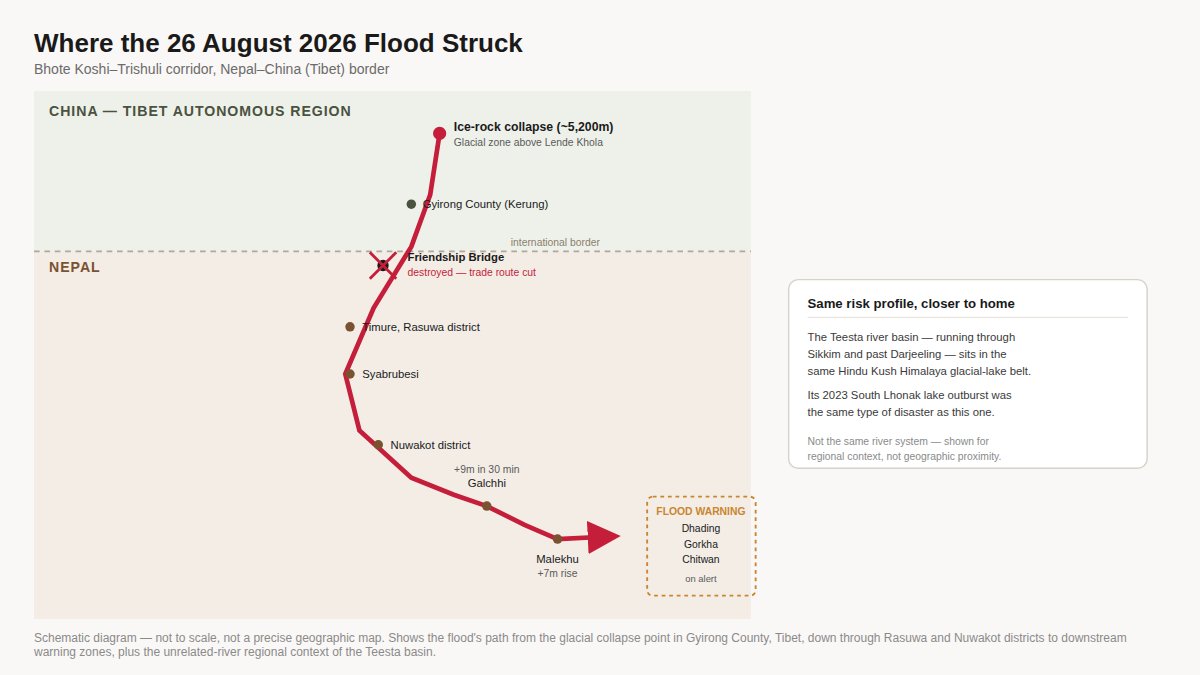
The 26 August 2026 flash flood that killed 160+ people and left over 1,444 missing along the Trishuli-Bhote Koshi corridor was not the first glacial-origin disaster to strike that exact stretch of river. It was the second in just thirteen months — and experts say the gap between the two events is the story.
A pattern, not a coincidence
On 8 July 2025, a glacial lake outburst flood struck the same Bhote Koshi river system, originating from Tibet's Lhende stream. That flood killed at least 9 people, left 19 missing, destroyed the Miteri Bridge connecting Nepal and China, and damaged the Rasuwagadhi dry port and hydropower infrastructure.
Thirteen months later, nearly identical flooding tore through the same corridor — this time with a death toll more than fifteen times higher.
| Event | Date | Deaths | Missing | Key damage |
|---|---|---|---|---|
| Bhote Koshi GLOF | 8 July 2025 | 9 | 19 | Miteri Bridge, Rasuwagadhi dry port, hydropower plants |
| Trishuli-Bhote Koshi flash flood | 26 August 2026 | 160+ | 1,444+ | Friendship Bridge, hydropower facilities, homes, roads |
Analysts covering the disaster put it plainly: the same river system produced two catastrophic, glacial-origin floods within thirteen months of each other, and that repetition is a pattern, not bad luck — a corridor that was flagged as high-risk after 2025 but was not brought under real monitoring before the next flood arrived.
Why the warning never came in time
Because the triggering ice-rock avalanche happened on the Tibetan side of the border, Nepal was dependent on China sharing information in real time — and that link did not exist. There is still no functional Nepal-China data-sharing arrangement for real-time hydro-meteorological monitoring of shared glacial rivers, and Nepal has no early-warning infrastructure on that stretch capable of detecting an outburst before it crosses into Nepali territory.
The warning-time math makes this gap especially costly. Once a flood wave starts moving, downstream settlements may get as little as five to thirty minutes of notice — far too short for evacuation unless automated detection and alert systems are already switched on and watching.
Warning times are measured in minutes, and any delay at a border is fatal.
Sensor networks using remote sensors, cameras, and satellite monitoring have been piloted in Nepal, Bhutan, Pakistan, and parts of China, but installing and maintaining equipment above 5,000 metres is difficult and expensive, and coverage stays limited mostly to the summer months.
Not just a Nepal problem — a Himalaya-wide pattern
This disaster sits inside a broader, worsening trend across the Hindu Kush Himalaya. Glacial lake outburst floods (GLOFs) have struck the region repeatedly in recent years:
- February 2021 — the Rishi Ganga disaster in Uttarakhand killed over 200 people and destroyed hydropower projects.
- October 2023 — the South Lhonak lake outburst sent destructive flooding down the Teesta river basin, the same river system that runs through Sikkim and past Darjeeling.
- August 2026 — the Rasuwa/Bhote Koshi flash flood.
ICIMOD (the International Centre for Integrated Mountain Development) expects GLOF frequency to keep rising as warming continues to form new glacial lakes and expand or merge existing ones, adding to the flood volume each one can release.
The Teesta connection matters directly for this region. The 2023 South Lhonak event showed that the same class of disaster striking Nepal's Bhote Koshi can happen just as easily upstream of Sikkim and the Darjeeling hills, on a river basin shared with these communities.
What experts say needs to happen next
Recommendations are consistent across the disaster-risk community covering this event:
- A formal cross-border data-sharing agreement between Nepal and China (and, by extension, India where shared basins like the Teesta are concerned), since a delay of even a few hours at a border can turn a survivable flood into a mass-casualty one.
- Satellite monitoring extended beyond known glacial lakes, to catch ice-rock avalanches like the one that triggered this flood — it did not come from a mapped lake at all.
- Updated land-use and hazard maps, so hydropower stations, roads, and settlements stop being sited using outdated historical flood data instead of current risk assessments.
The bottom line
Two catastrophic floods on one river corridor in thirteen months is being read by disaster-risk experts as a missed opportunity: the 2025 flood should have forced monitoring and cross-border coordination onto that stretch of river before 2026's flood arrived. For communities across the wider Himalaya sharing the same glacial-lake exposure — Darjeeling and Sikkim included — the lesson being drawn is the same: early-warning systems only work if they are built and linked across borders before the next event, not after it.
---
Sources:
- A pattern ignored: The Bhote Koshi disaster reveals Nepal's transboundary blind spot
- Early warning could have saved hundreds of lives in Nepal floods — Nature India
- Rasuwa Flash Flood Renews Fears of Himalayan GLOFs — Down To Earth
- Himalayan Disaster: August 2026 Bhote Koshi Deluge — SANDRP
- Rasuwa flood raises questions over Nepal's early warning system — OnlineKhabar
Have a tip on this story?
WhatsApp Khabar Darjeeling at our channel or email nowanad@gmail.com. Your identity will be protected.
© 2026 Khabar Darjeeling
By Adhar limbu
All rights reserved. Content may not be reproduced without permission.