
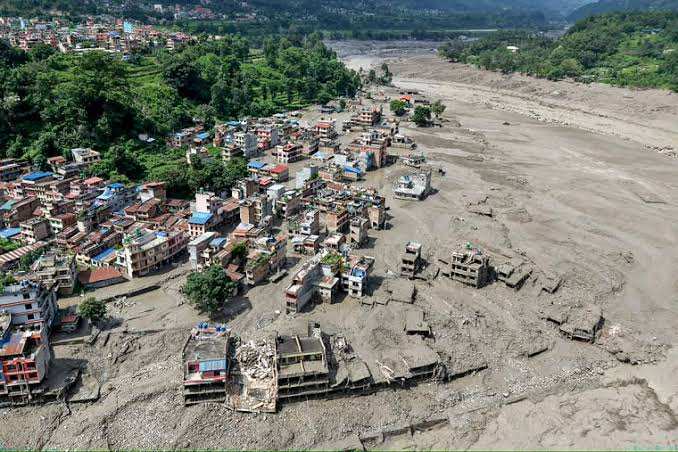
Aerial view shows a town in Rasuwa district buried under mud and debris after the Bhote Koshi river burst its banks on August 26, 2026, destroying homes and infrastructure across the Nepal-Tibet border region.
Nepal-Tibet Flash Flood: Death Toll Passes 160, Over 1,000 Still Unaccounted For Across Two Countries
Glacier collapse on the Lhende Khola sends catastrophic surge down the Bhote Koshi and Trishuli rivers, devastating Rasuwa district and Tibet's Gyirong border crossing
What began as a sudden surge on a Himalayan tributary early Wednesday morning has grown, over the course of the day, into one of the deadliest cross-border disasters the region has seen in years. As of the latest confirmed figures, at least 157–160 people are dead in Nepal, with three further confirmed dead and 265 people missing across the border in Tibet's Gyirong County — bringing total confirmed and missing figures across both countries into the hundreds, with search-and-rescue teams still working through debris-choked valleys.
What Happened, and Where
The flood began around 9 AM local time when water levels on the Bhote Koshi River suddenly surged. The source has since been traced to the Lhende Khola (Lende River), a smaller tributary that flows down from Gyirong County in Tibet before joining the Bhote Koshi and, further downstream, the Trishuli river system.
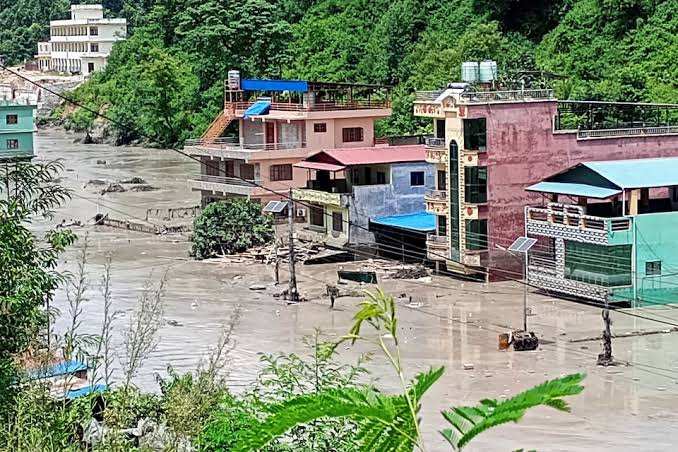
The wall of water and debris first tore through the border settlements of Timure and Syabrubesi in Rasuwa district, before racing downstream into Nuwakot, where it flooded commercial areas including Betrawati, Trishuli, Dhunge and Devighat. Flood warnings were subsequently extended further downstream to Dhading, Gorkha and Chitwan districts as the surge propagated through the wider river network — which is why casualty figures span seven Nepali districts rather than one.
On the Tibetan side, the flood devastated Gyirong Port, a major China–Nepal trade and pilgrim crossing. Chinese state media has reported 3 confirmed deaths and 265 people missing at that location alone, underlining that this is very much a cross-border disaster rather than one confined to Nepal.
Nepal's Prime Minister Balendra "Balen" Shah has named the worst-hit municipalities as Bidur in Nuwakot; Uttargaya and Gosaikunda in Rasuwa; and Gajuri, Galchi, Benighat, Tripurasundari and Siddhalek in Dhading, alongside affected areas of Gorkha.
What Triggered It: A Glacier Collapse, Not Simple Rainfall
The investigation into the exact trigger is still active, but a clearer picture has emerged over the course of the day, and it points well upstream of Nepal's own weather.
Satellite imagery from Planet Labs, reviewed by geologists, shows the lower snout of a glacier broke away at roughly 5,200 metres elevation and crashed some 1,200 metres down onto the valley floor, dragging rock and sediment with it. Vikram Gupta, an engineering geologist at Sikkim University, confirmed that "a substantial portion of that glacier snout collapsed to initiate the event." Prakash Pokharel, a geologist with Nepal's National Disaster Risk Reduction Authority, likewise attributed the flood to an ice-rock avalanche on the Nepali side.
Nepali officials believe the avalanche debris first blocked the Lhende Khola outright, forming a temporary debris-dammed lake; when that natural dam gave way, it unleashed the catastrophic burst of water that reached the Bhote Koshi. Rijan Bhakta Kayastha, a climate researcher at Kathmandu University, described it as an ice avalanche that blocked the Lhende river and triggered the flood — a mechanism consistent with what scientists call a glacial lake outburst flood, or GLOF. ICIMOD (the International Centre for Integrated Mountain Development) has separately identified this Poiqu/Bhote Koshi watershed as a zone already known to be highly prone to GLOFs.
An early theory that an earthquake triggered the avalanche — floated by Nepal's foreign minister, who cited a roughly seven-minute gap between a seismic event and border CCTV footage of the flood — appears to be, at minimum, incomplete. A magnitude 5.2 seismic event was recorded in the area on August 26, but geologists including Kayastha now believe this signal is more consistent with the sound and shock of the mountainside collapsing than with an independent triggering earthquake — in other words, the "quake" was likely the avalanche itself, not a separate cause of it.
A further contributing factor: Dan Shugar, an earth scientist at the University of Calgary, examined satellite imagery showing extensive snowmelt in the 24 hours before the disaster — glaciers that appeared snow-covered a day earlier showed up as bare ice, suggesting unusually warm conditions had already begun destabilizing the slope before it gave way.
Whatever combination of factors proves decisive, the result was violent: ICIMOD says the surge pushed a mix of water, sediment and boulders downstream so forcefully that water levels at Galchhi, further down the Trishuli, rose by as much as 9 metres (30 feet) in just 30 minutes.
The Climate Backdrop
Scientists studying the Hindu Kush Himalaya point to a broader warming trend as the reason events like this are becoming more frequent, not just this one collapse in isolation. A 2023 UN assessment found Nepal's glaciers had lost nearly a third of their ice over three decades, with the melt rate in the most recent decade running 65% faster than the decade before — a trend researchers link partly to Nepal's glaciers sitting between two of the world's largest carbon emitters, India and China. ICIMOD has separately warned that floods, landslides, avalanches and droughts are all increasing in frequency and severity across the wider Hindu Kush Himalayan region as a result.
The Human Toll
Nepal's death toll has climbed in stages through the day — from single digits in the earliest hours to 22, then 72, then past 157 — the kind of trajectory typical of a disaster where recovery and identification are still ongoing. As of the most recent Nepal-side breakdown, deaths span seven districts: Chitwan, Dhading, Nuwakot, Gorkha, Tanahu, Rasuwa and Nawalparasi East.
Missing-person figures are similarly still being reconciled and differ somewhat by source and hour. Nepal's Tourism Board has been verifying the whereabouts of missing travelers, with early counts around 384–400 (including roughly 291–466 foreign nationals) and later updates from some outlets putting the figure higher, near 579 — a rise likely reflecting more thorough manifest-checking rather than a new wave of casualties. Indian nationals make up a significant share of the missing: at least 105 Indians, including 37 non-resident Indians and 59 pilgrims en route to the Kailash Manasarovar Yatra, along with 8 South Koreans, 3 Americans, and travelers from the UK, Malaysia, Australia, South Africa and the Netherlands.
Beyond tourists, roughly 9 to 32 Armed Police Force and Nepal Police personnel stationed at the Timure border outpost remain unaccounted for (figures vary by update), along with dozens of hydropower workers cut off from contact — including staff and tunnel workers at the Langtang Khola project — plus employees of customs offices and bank branches swept away in Timure and along the Bhotekoshi corridor.
There were 25 people, including engineers, drivers and kitchen staff, and another 35 were working inside the tunnel. We have not been able to contact them since morning.
Infrastructure Damage
Nepal's Electricity Authority has confirmed damage to at least six major hydropower and transmission facilities: the Rasuwagadhi, Chilime, Trishuli 3A and Trishuli hydropower stations, the Trishuli 3B Hub 220kV substation, and the Devighat Hydropower Station. Multiple commercial bank branches along the Bhotekoshi corridor were swept away entirely, and roads, bridges and communications links across Rasuwa, Nuwakot and Dhading have been severely damaged, which is itself slowing the rescue effort.
The Response
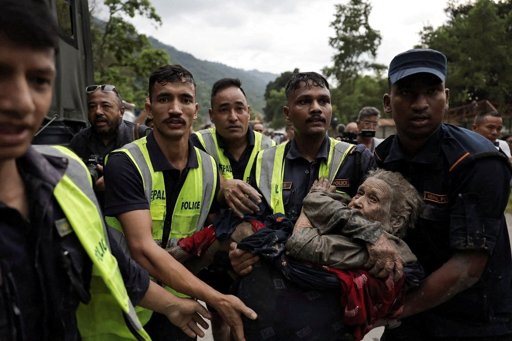
Nepal's Army, Armed Police Force and Police, backed by helicopters, have rescued more than 250 people so far, with search operations continuing despite the damaged roads and disrupted communications that are hampering access to some of the worst-hit and most remote sites. Nepal's government has released emergency funds to the hardest-hit districts — Rs 10 million each to Rasuwa and Nuwakot, and Rs 5 million to Dhading — for rescue, relief and emergency management, and has ordered free medical treatment for flood victims. President Ram Chandra Paudel has urged PM Balen Shah to mobilize the full machinery of the state for rescue and relief.
India, given the large number of its citizens and pilgrims caught up in the disaster, has dispatched roughly 10 tonnes of relief material and essential medicines to Nepal via Indian Air Force aircraft, with Prime Minister Modi speaking directly with PM Shah to pledge continued support. India's Ministry of External Affairs has activated helpline coordination for affected families, and alerts have been issued in Uttar Pradesh and Bihar, the Indian states bordering Nepal, as authorities watch for downstream effects on shared river systems.
What We Still Don't Know
The precise mechanical sequence — glacier collapse, ice-rock avalanche, debris-dam formation and, possibly, a GLOF-style burst — is still being finalized by Nepali and Chinese scientists working from satellite data, and the earthquake question in particular remains only provisionally resolved. Nepal's death toll is very unlikely to be final; given how sharply it has already climbed, and how many hydropower, security and customs personnel remain out of contact, further increases are plausible over the coming days. Missing-person totals on both the tourist and worker side are still being reconciled between agencies, which is why figures continue to shift between reports.
Why This Matters for Our Readers
The Bhote Koshi and Trishuli river system, and the glacial terrain around Rasuwa, sit in the same eastern Himalayan belt that periodically threatens Sikkim and North Bengal's own river systems with GLOF and avalanche risk — this is not a distant story for readers in the hills.
As of this writing there is still no confirmed report of Darjeeling-origin or North Bengal travelers among the missing or dead, and that distinction is worth holding onto rather than assuming from geography alone.
But given how many Indian pilgrims and tourists — including groups headed for Kailash Manasarovar — have been swept into this disaster, it is likely to resonate strongly with readers here, and is worth following as both a humanitarian story and a cautionary one about the risks building up in our own shared mountain range. We will update this report as Nepal's and China's figures are further confirmed.
*This report reflects developing coverage as of the evening of August 26, 2026 (IST). Casualty and missing-person figures from both Nepal and China are still being verified and reconciled by officials and should be treated as provisional.*
Sources: CNBC, France24, South China Morning Post, The Standard (HK), CNN, Al Jazeera, NPR, NBC News, Reuters (via US News/WHBL/WIKY/Internazionale), Kathmandu Post, Down To Earth, ANI News, Gulf News, Xinhua, The Federal, Deccan Chronicle, Outlook India, Washington Post, Euronews
Have a tip on this story?
WhatsApp Khabar Darjeeling at our channel or email nowanad@gmail.com. Your identity will be protected.
© 2026 Khabar Darjeeling
By Adhar limbu
All rights reserved. Content may not be reproduced without permission.