
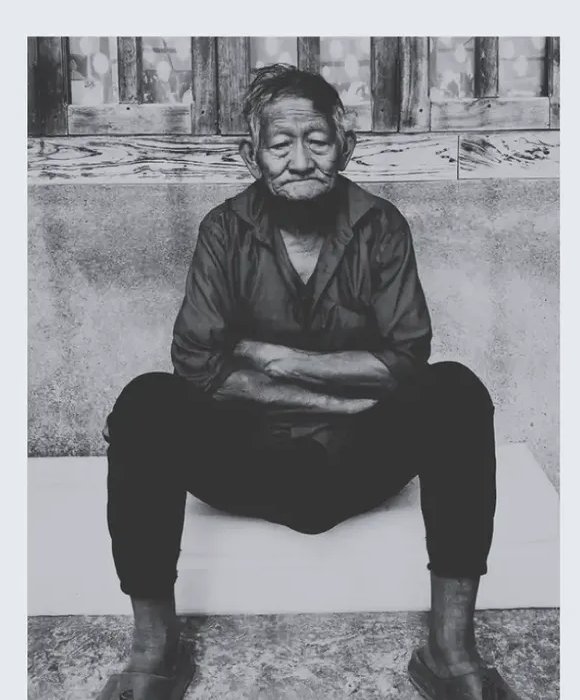
Bir Bahadur Limbu, 83, the sole surviving witness of the 1966 Rangbull Tea Estate shooting. (Photo: Astitwa, republished with permission)
A Cup of Tea and Tears: The Untold Story of the Dooteriah Balasun Rangbull Tea Estate Shooting
"They cannot represent themselves; they must be represented." — Karl Marx
"The bullet was out after nine days," says Mr. Bir Bahadur Limbu, looking at the scar it left behind. Now 83 years old, he is the sole surviving witness of the Dooteriah Balasun Rangbull Tea Estate shooting of 1966 — an incident that took place a decade after the far better-known 1955 Margaret's Hope shootout, but has never found a place in official records or the mainstream retelling of Darjeeling's tea history.
"The other workers are no more," he says quietly. What follows is his account of that day, and of a lifetime spent waiting for an acknowledgement that never fully came.
A wage that couldn't stretch, and a bridge that couldn't be crossed
"It was the year 1966, and it was too difficult to make ends meet — it was too expensive," Mr. Limbu recalls. The daily wage at the time, half an anna, wasn't enough to sustain a basic standard of living. Workers at the Rangbull Tea Estate had been protesting for higher wages, and by the time tensions peaked, the estate had already been shut for eighteen days as a form of protest.
A bridge physically separated the workers' homes from those of the "maliks" — the estate owners and management. Workers were warned not to cross it; doing so would be treated as defiance of the authorities, who had been ordered to fire if that line was crossed.
"They were scared we would destroy their cottages, so they had deployed scary-looking policemen," Mr. Limbu says. "We never crossed the line, though — we were civil and reasonable. It was some hooligans who threw stones while the police and workers were having a heated discussion, and all hell broke loose."
August 25, 1966
On that day, the workers had finally decided to approach the authorities through dialogue. But a brawl broke out, and it took only a single stone for police to open fire on the workers — ordinary civilians standing at the negotiating table.
Mr. Limbu was shot in the leg. His friend, Mr. Birey Pradhan, was shot dead beside him. "My other friend and some more workers got injured from the bullet jilts, and some [were] lathi charged," he recalls.
In the moment, he says he didn't feel the pain of his own wound — what he remembers is his friend lying lifeless in front of him.
The government covered his month of hospital treatment in full. But Mr. Limbu isn't sure why.
"I don't know if they did that because they knew they were wrong, or it was an effort to cover up the entire thing because they did not record anything."
After being discharged, he didn't go home. He and his friends spent another twenty-eight days in jail. Governments changed in the years that followed, and compensation was eventually granted to the victims — but it stopped after a few years, and was never restored.
A festival for tea, but not for the people who grow it
Asked whether he'd heard of the Melo-Tea Fest, an event celebrating Darjeeling's tea, Mr. Limbu looked amused rather than pleased. "No, I do not know anything of that sort," he said. "Does it benefit the workers?"
The Rangbull Tea Estate shut down a few years ago. Workers who depended on it for generations were forced to leave the village to feed their families.
"When I was young, one's fate was sealed," he said. "If you were born into a mazdoor's family, you would follow your parents. But the younger generation knows that the wages will not give them a good standard of living."
The daily wage for tea garden workers in 2026 stands at ₹250 — a figure Mr. Limbu's interviewers point to as evidence that little has structurally changed since 1966, even as the industry his labour built continues to be celebrated elsewhere.
An unrecorded history, and a quiet hope
The Rangbull Tea Estate shooting is not an isolated incident, but part of a longer, largely undocumented history of violence following tea workers' demands for fair wages — one the interviewers describe as a pattern of systematic marginalisation that mainstream narratives have simply left out.
Asked, at the end of the interview, whether he thought things would ever change, Mr. Limbu paused for a long moment before answering.
"Yes? Maybe? I still keep my documents intact, because one day I think we might be compensated."
"We deserve that right?" he asked, looking at his interviewers with a glimmer of hope.
---
*Originally published by Astitwa. Compiled by Shreya Sri Rai and Shreyashi Subba. Republished with permission.*
*About the authors: Shreyashi Subba is an independent writer and artist from the hills of Darjeeling, whose literary work focuses on book reviews and, more recently, articles on Darjeeling's literature. Shreya Sri Rai, also from the hills of Darjeeling, is currently pursuing a Master's in English Literature.*
Have a tip on this story?
WhatsApp Khabar Darjeeling at our channel or email nowanad@gmail.com. Your identity will be protected.
© 2026 Khabar Darjeeling
By Adhar limbu
All rights reserved. Content may not be reproduced without permission.